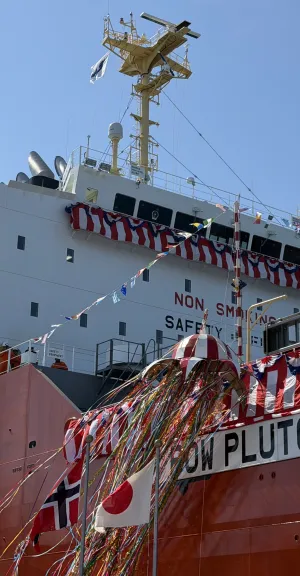
The traditional ceremony brought together representatives from the shipowner and Odfjell, shipyard and key partners. As one of the founders of modern chemical tanker shipping, Dan Odfjell Sr. offered a personal reflection on Odfjell's long history with Japan and the company's development over the decades. Now 88 years old, and speaking with characteristic warmth and humor, he recalled his first visit to Japan:
"I visited Japan for the first time in 1960. That's 66 years ago. It was April and cherry blossom time. I arrived in Yokohama as a seaman of the Wilhelm Wilhelmsen Line, and within three weeks, I shifted over to a very small Odfjell tanker bound for California for another cargo of bulk liquid chemicals," he said.
The company pioneer’s remarks underscored the ties between Odfjell and Japan that have evolved over generations. The cooperation with Kithanihon stretches back more than twenty years: The yard delivered the first Odfjell vessel, Bow Architect, in the early 2000s and has since become a trusted partner in constructing several vessels for our fleet of high-quality chemical tankers.
Advancing decarbonization through energy-efficient technology
The 28-tank stainless steel tanker represents the most advanced design in our fleet. Equipped with both gate rudder and foldable wind-assisted propulsion sails, Bow Tanaka is designed to significantly reduce fuel consumption and emissions while maintaining the highest standards of safety and operational performance. Results from the sister vessel Bow Erikson show an improvement against comparable Odfjell vessels of around 18-20%.
The vessel's name suits a frontrunner well: She’s named after Tanaka Shosuke, the first recorded Japanese person to cross the Pacific to the Americas in 1610. The new supersegregator now carries the explorer’s legacy forward in our round-the-world trade.