This story is a translated version of an article first published by Skipsrevyen, November 2025 issue.
Written by Ruben André M. Njøtøy
When Harald Fotland became the CEO of Odfjell SE in 2022, the world had barely caught its breath after the pandemic before new crises emerged. War, sanctions, and volatile markets became a part of everyday life—but for Fotland, meeting challenges was nothing new.
“You learn early to deal with one challenge at a time”, Fotland says. “It is impossible to solve them all at once.”
With a background ranging from the Navy and marine insurance to leading one of the world’s largest chemical shipping companies, Fotland is used to standing in the middle of a storm. For him, strong leadership is about being calm, clear, and respectful—both for the people around him and the complexity of the operations he leads.
“I don’t believe in being best at any cost. The most important thing is to understand what you are good at, and to be confident enough to build on that.”
Behind the CEO’s composed exterior lies a clear driving force: a desire to develop, simplify, and strengthen a shipping company that has gone through major changes.
“I have been shaped by years in a work culture where you are given responsibility early and are expected to stand by your decisions. That has left its mark.”
Best in class
Fotland entered the Norwegian Naval Academy in the mid-1980s—“a bit from the sidelines,” he adds.
“What is great about the military is that young people are given leadership experience early on,” says Fotland.
“I had high respect for my classmates and often felt they were ahead of me, which motivated me to work much harder to keep up. That’s likely why I graduated at the top of my class,” Fotland explains.
After passing the officer course on MTB (motor torpedo boat), he became commanding officer already in his early twenties.
“You are being placed in demanding situations early on. You see the effect of your own leadership, a foundation of experiences that you carry with you throughout life.”
Fotland describes the years in the military as educational but also as a time formed by rapid decisions and responsibility.
“I never wanted to be the best. I just wanted to be as good as everyone around me. But then the question is: where do you set the bar to be ‘just as good?’”
After several years as commanding officer, he was offered a position at the headquarters in northern Norway, Bodø. When family life made the transfer challenging, he chose to move over to the civilian maritime sector.
“I really enjoyed the Navy; it was an incredible workplace. However, at a certain point it was just not compatible with family life.”
Close to ‘Rocknes’
Over ten years, Fotland gained new perspectives on risk and decisions at marine and energy insurer Gard.
“At Gard, I worked on cases that were both technically and humanly challenging. You’re exposed to everything that can go wrong in shipping,” Fotland says.
“Insurance is a school in risk awareness. You’re taught to evaluate, price, and manage risk, and you’re constantly exposed to everything that can go wrong in the world. That shapes how you think as a leader.”
He remembers three cases that left particular impressions: a complex wreck removal in Australia, the ‘Rocknes’ accident in 2002, and the ‘Server’ grounding near Fedje.
“The wreck removal in Australia was technically extremely complex. ‘Rocknes’ and ‘Server’ were different—they took place in our own backyard; that made a lasting impression.”
The experiences from Gard gave him a deep respect for crisis management.
“You are placed in demanding situations at a very early stage. You experience the real impact of your own leadership, and that gives you a base of experience that you carry with you for the rest of your life.”
Everything had to change
“We had been through ten years with poor results. Our equity was depleted, and it was an agreement between both the management and the board that something had to be done”, he says.
The measures were drastic. The number of staff in Bergen was reduced by 40 percent—nearly a hundred people.
“The entire process was deeply distressing. I remember the meeting we had just after New Year's in 2015, where we had to tell multiple employees that this is not going well; we have to downsize. That was very tough.”
He describes a workplace filled with uncertainty but also strong unity in otherwise divisive times.
“Lunchtime took on a strange atmosphere. There were 150 employees staying on and 100 being gradually phased out. Sitting next to someone who knew they would keep their job, while you were aware that you had lost yours, created a very special atmosphere.”
The process went on for almost a year. For Fotland, it was important to ensure a dignified and respectful treatment of those who had to leave.
“We put a great deal of effort into securing good arrangements. We followed up closely with those who were made redundant, and I believe that—with a few exceptions—everyone found a new job well before their notice period ended.”
Over time, the mood began to shift.
“When the first people who left managed to secure new jobs, it changed a lot. Those who knew they were leaving could see that things actually worked out. That gave hope, and the atmosphere improved.”
After nearly 15 years at Odfjell, Fotland has held responsibility for almost every part of the organization—from operations and IT to communications and ship management. This has given him a rare insight into how the company truly functions.
“The only departments I haven’t had direct responsibility for are finance and the terminal business. Otherwise, I have worked my way through most of it,” he says. His broad experience has made him a leader with both perspective and deep insight.
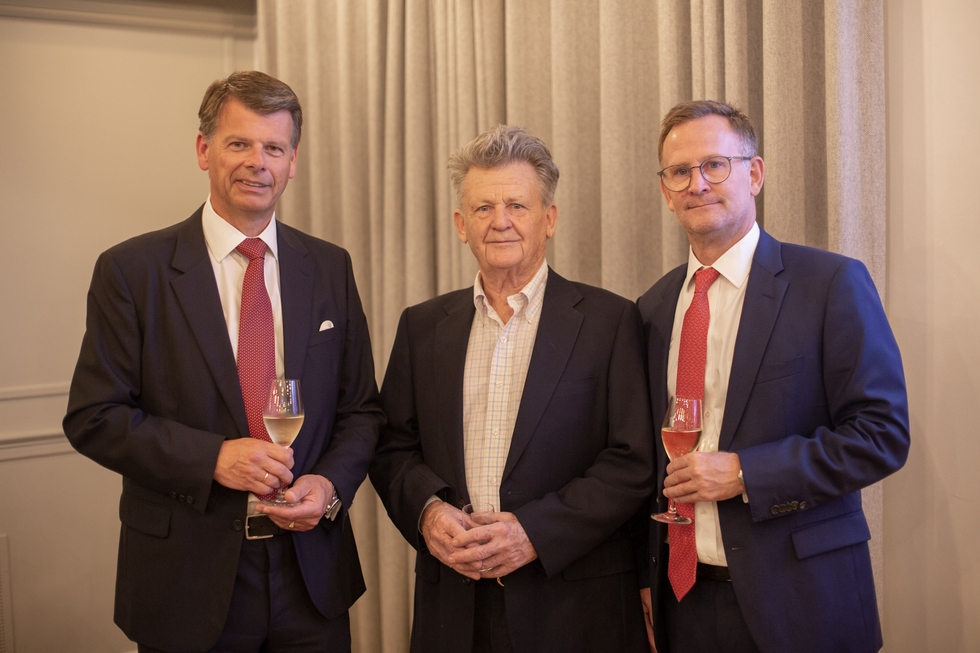
Harald with Dan Odfjell and current Chair, Laurence Odfjell in 2022.
“For good and for bad, I understand many of our internal processes better than what is normal for a CEO. That means we have good discussions – but it also means it’s not that easy to fool me”, Fotland says with a smile.
He knows most of the employees by name.
“I know almost everyone who works here, apart from the very newest. That also means I set clear expectations. They know that when they come to me, they need to be well prepared.”
Fotland believes this experience has also made him more realistic.
“When new projects come in from IT, communications or operations, I know what lies behind them. I can ask the questions that are relevant, and that sets the standard for how we work.”
“For better and for worse—a structure I know inside out.”
In 2022, Fotland took over as CEO of Odfjell. At that point, the world was anything but stable. The pandemic had barely loosened its grip when Russia invaded Ukraine, and shortly after, the shipping industry was hit by a new wave of global crises.
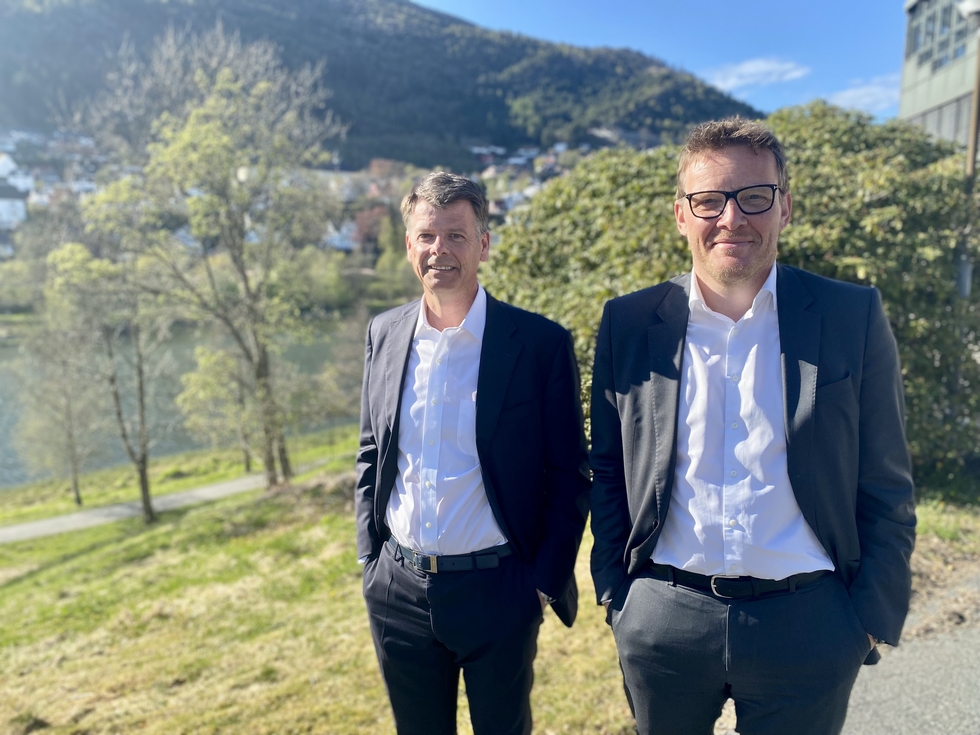
Harald Fotland took over the reigns at Odfjell from Kristian Mørch in 2022.
“We operate just over 70 vessels and are among the world’s largest in chemical transportation. But the past five years have been shaped by geopolitics in every possible form.”
He highlights, among other things, the pandemic, the war in Europe, and the Hamas attack as key challenges.
“The Hamas attack led to the closure of the Red Sea, and now we are facing new tariff regimes after the U.S. election. It’s been a year where external conditions have influenced absolutely everything we have done.”
For Odfjell, which sails globally, every political decision can mean altered routes, longer voyages, and multimillion-dollar cost impacts.
“When we call at the major ports, we typically visit between six and ten different berths, and during the pandemic, the regulations could change from one berth to the next. You have to be able to adapt, and you have to do it fast.”
He recalls an incident where the situation in the Red Sea intensified, necessitating a swift decision.
“We had a ship heading south through the Suez Canal. After a quick assessment we said: “This won’t work. You have to turn around.” It cost a couple of million dollars, but we couldn’t risk sending our people through. Safety comes first.”
For Fotland, leadership in such times is about staying calm and prioritizing correctly.
“That’s something I have taken with me from both the Navy and Gard: you have to solve one problem at a time. You can’t believe you will fix everything at once. Identify what matters the most, use the organization, divide responsibility, and focus on what is most important right now.”
Fotland describes a company with a strong culture of safety, precision, and continuous improvement.
“We accept zero failures on safety. That attitude extends from the accounting department to the captain on board. At the same time, we are solution-oriented—our customers know that we get things done.”
Fotland points to digitalization as a decisive force in the company’s development.
“When we became fewer after the downsizing, and some departments had to increase their workload, we were forced to think smarter. That created a strong willingness to adopt digital tools.”
He now overlooks the first steps into a new technological era.
“Artificial intelligence is developing faster than we can produce strategy. I have never experienced technology advancing at such a pace. But there are enormous opportunities there—for safety, efficiency, and costs.”
“You try to make a good plan, and when you think you finally have one, you see that the technology has already taken it another step forward. Then you have to make a new one.”
Still, Fotland says he is not afraid of technological development but more concerned with the resources required to make the right choices.
“It doesn’t scare me, but it is challenging. The question is how many resources are needed to take the right steps. At the beginning, it feels a bit like basic research—you spend money without fully knowing what you will get back. Right now, I’m more focused on the opportunities than the threats,” Fotland says.
“But I’ll probably become more worried over time.”
As both CEO of Odfjell and president of the Norwegian Shipowners’ Association, Fotland is closely involved in the development of Norwegian and international shipping.
“The green transition will be the greatest driving force in shipping over the next decade,” says Fotland. “But right now, I feel there is headwind. European industry is struggling to keep pace, the U.S. has pulled the handbrake, and Norway has recently admitted that we will not reach our 2030 climate targets.”
Despite this, he remains determined. Odfjell has already invested more than half a billion Norwegian kroner in energy-efficient solutions and continues to cut emissions—independent of political tempo.
“We will continue on the course we are on. We will simply become even better,” says Fotland.
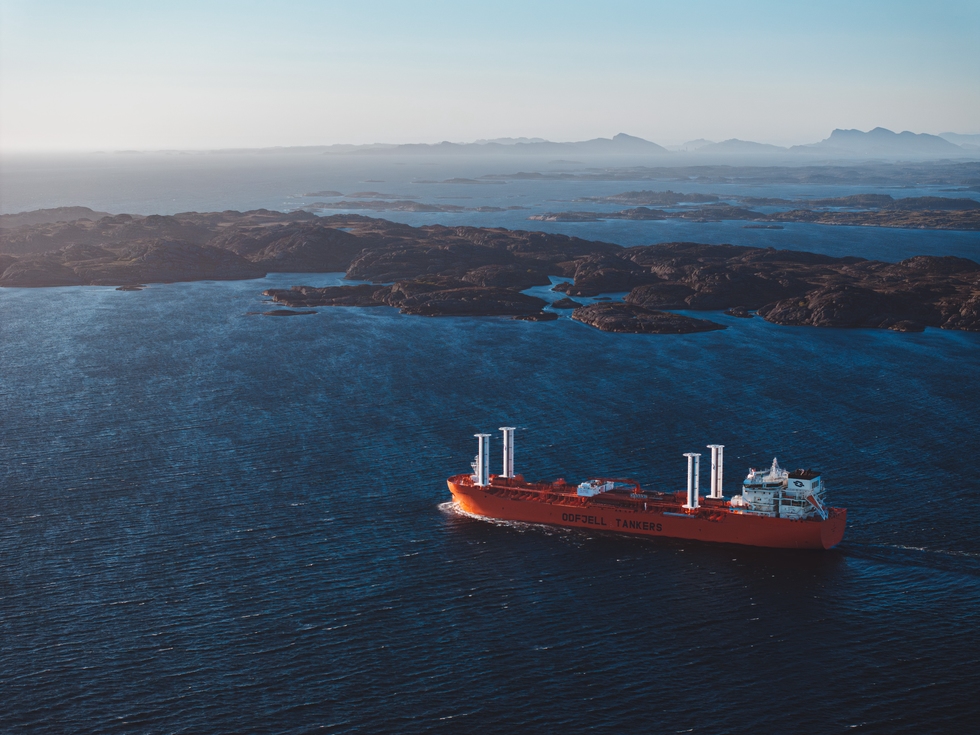
The suction sails on Bow Olympus is one of many energy-efficiency measures Odfjell has taken in recent years. Photo: Ruben Soltvedt
He is also clear about what is required for Norway to maintain its maritime position.
“Predictable framework conditions. That is absolutely crucial. Most Norwegian shipping companies are structured in such a way that they could relocate abroad tomorrow. That is why politicians must understand how dependent Norway is on the coast and the ocean.”
After several decades in an industry shaped by change, technology, and crises, Fotland still speaks warmly about the future.
“The most inspiring thing is the young people. Those who join our offices or our vessels full of energy, drive, and new ideas. It doesn’t just give me hope—I know they will succeed. There is so much competence, so much determination. I have told our leaders that you notice it the moment you meet them.”